POAS vs ROAS, Why the Wrong Metric Is Eating Your Profit
Your ROAS is climbing but profit is flat. The problem is the metric, not the campaign. How to calculate POAS and why it's the only metric that matters for profitability.
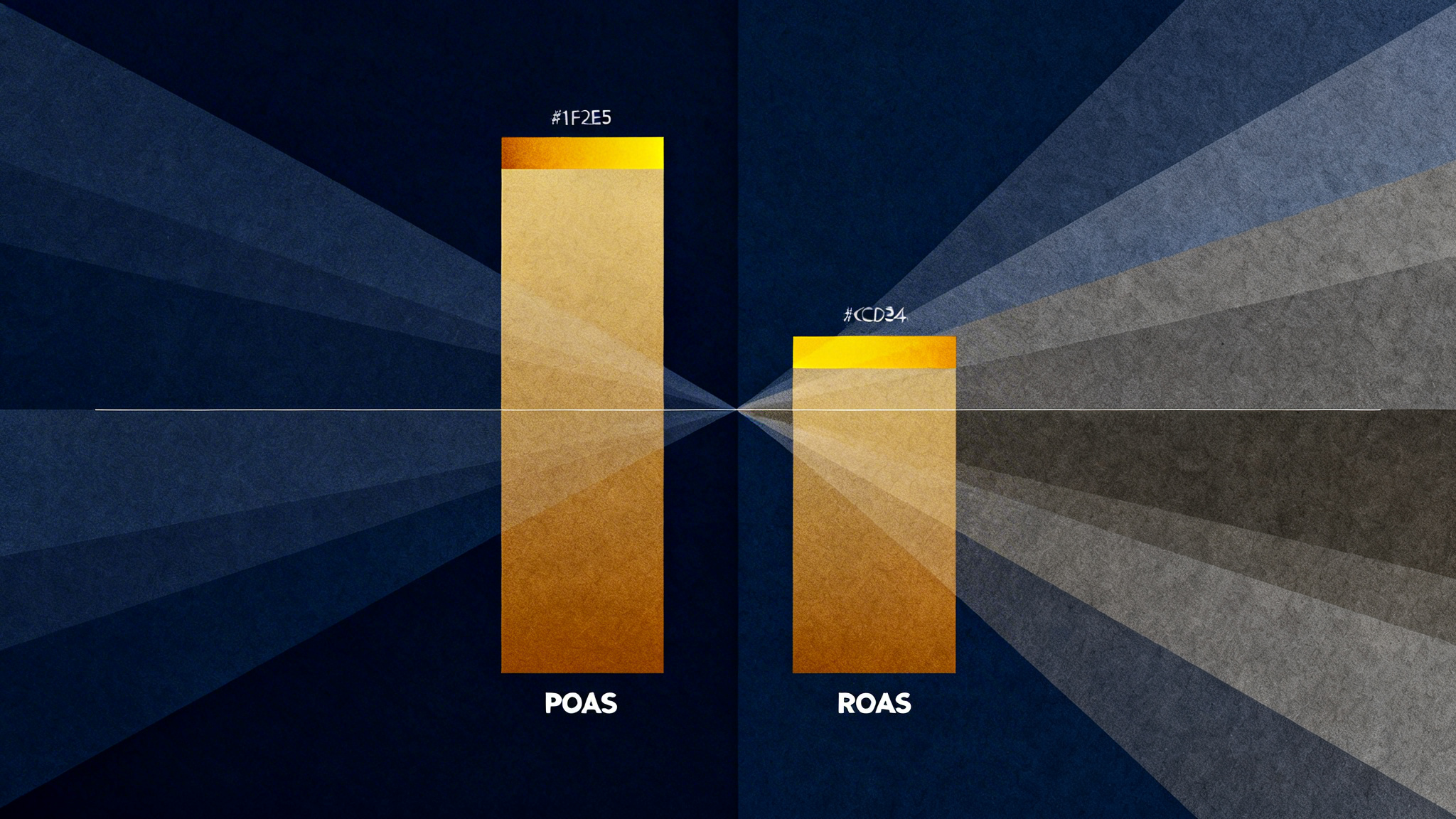
ROAS looks great. Profit isn't growing. Why?
It's the most common scenario we see, an online store with ROAS of 5, 6, even 8 - and an owner who can't understand why there's no money left at the end of the month. On paper, the campaign looks flawless. In reality, profit tells a different story.
The problem isn't the campaign. It's the metric you're tracking.
ROAS measures how much revenue you generate per unit of ad spend. It doesn't measure how much your business actually earns.
What is ROAS and why isn't it enough?
ROAS (Return on Ad Spend) is calculated simply:
Sounds good. But ROAS doesn't know:
- What gross margin each sold product has
- What order processing, returns and shipping cost
- How much of the attributed revenue is actually net revenue
- Whether you're selling products with 10% or 60% margin
A ROAS of 5x can be excellent for a product with 50% margin. That same ROAS of 5x is a disaster for a product with 15% margin.
What is POAS and how do you calculate it for your store?
POAS (Profit on Ad Spend) puts real profit into the equation, not gross revenue:
Gross profit = Revenue - Cost of goods (COGS) - Variable costs (shipping, processing, returns)
What happens concretely when you look at the same account through ROAS vs POAS?
The ROAS perspective
- Ad spend, the reference figure
- Revenue generated, 6 times the spend
- ROAS, 6x - excellent
- Conclusion, successful campaign
The POAS perspective
- Ad spend, the same reference
- Gross profit generated, 0.9 of the spend
- POAS, 0.9x - below breakeven
- Conclusion, unprofitable campaign
Same account. Same data. Opposite conclusion. The difference, promoted products had 15% margin, and the breakeven ROAS should have been at least 6.7x, not 6x.
How to calculate your breakeven ROAS
1Calculate gross margin
Gross margin (%) = (Revenue - COGS - Variable costs) / Revenue × 100
2Calculate minimum ROAS
Breakeven ROAS = 1 / Gross margin (as decimal)
Ex, 25% margin → minimum ROAS = 1 / 0.25 = 4x
3Set a real target
Target ROAS = Breakeven ROAS × 1.2-1.5 (for net profit after overhead)
Ex, minimum ROAS 4x → target 5-6x
How do you implement POAS in your campaigns?
Calculate margin per product or category
You don't need perfect precision. Group into 3 buckets, low margin (<20%), medium (20-40%), high (>40%).
Set different target ROAS per product group
Low-margin products need a higher target ROAS. Don't treat the entire catalog the same way.
Exclude unprofitable products from campaigns
A product with 8% margin shouldn't be in Google Shopping unless you can achieve ROAS >12x. Better not to promote it at all.
Track POAS monthly, not ROAS
Add one column to your monthly report, gross profit generated by advertising vs. ad cost. If it's below 1, the campaign costs more than it brings in.
A ROAS of 4x is excellent at 35% margin. It's a loss at 20% margin. Context matters more than the number.
Why Switching to POAS Is Harder to Implement Than to Understand
The formula is simple. The problem is that not all stores know their real margin per product or category. Some have COGS calculated incorrectly, others include fixed costs in the margin and end up with distorted figures. Before you can set different target ROAS on margin-organized campaigns, you need clean data from accounting or ERP, not estimates.
And even with the data, implementation in Google Ads requires a campaign structure organized by margin category, with different target ROAS per group. That's not a 10-minute setting. It's a restructuring that affects how the algorithm optimizes. If you're just starting with paid advertising, read the realistic 90-day process for launching profitable campaigns first. If you're already managing multiple channels, the omnichannel strategy for online stores shows how POAS applies across the full Google + Meta + Email mix.
Frequently asked questions
What is the difference between ROAS and POAS?
ROAS (Return on Ad Spend) measures revenue generated per unit of ad spend, without accounting for product cost or variable expenses. POAS (Profit on Ad Spend) measures actual gross profit generated per unit of ad spend. A ROAS of 6x can mean a net loss if product margins are below 17%, while a POAS above 1 confirms that every unit invested generates real profit.
How do I calculate POAS for my online store?
You calculate POAS by dividing the gross profit generated by advertising by the advertising cost. Gross profit = revenue generated minus cost of goods (COGS) minus variable costs (shipping, processing, returns). For example, if a campaign generates revenue four times the ad spend, and COGS plus variable costs come to 70% of that revenue, the gross profit left is 1.2 times the spend, so POAS = 1.2 and the campaign is profitable.
What is a good ROAS for an online store in Romania?
There is no universally good ROAS because everything depends on your product margins. The correct formula, breakeven ROAS = 1 divided by gross margin (as decimal). With a 25% margin, the minimum ROAS to break even is 4x. A realistic target ROAS would be 5-6x to also cover fixed costs. Romanian stores with thin margins (10-15%) need a ROAS of 7-10x to be profitable.
Why does my ROAS keep going up but my profit stays flat?
The most common reason, you are promoting products with different margins without differentiating target ROAS. Google's algorithm optimizes for maximum revenue, not profit. It may choose to promote high-priced, low-margin products, generating impressive ROAS but minimal profit. The solution is to calculate margin per product category and set different target ROAS, higher for low-margin products, lower for high-margin ones.
How often should I calculate POAS for my Google Ads campaigns?
POAS is calculated monthly, not daily. Decisions based on daily data are volatile and lead to premature changes that reset the algorithm learning phase. At the monthly level, you have enough data to identify real trends. Add one column to your monthly report, gross profit attributed to advertising versus advertising cost. If the ratio is below 1 for two consecutive months, the campaign needs restructuring.
Can a paid media agency optimize campaigns for POAS?
Yes, but only if you give them access to margin data. An agency cannot optimize for profit without knowing how much you earn on each product or category. If your agency optimizes exclusively for ROAS without knowing your margins, they cannot make decisions aligned with your business profitability. Explicitly ask them to work with different target ROAS per product groups organized by margin.
At DAFE Digital we optimise campaigns on POAS, not ROAS. Real profit matters more than ad-generated revenue.
ROAS ignores margin - and campaigns optimised exclusively on ROAS can erode profit without appearing to have a problem. We optimise on the metric that matters for your business profitability, not the easiest one to report.

Adela Mincea
Fondatoare și strateg în marketing de performanță · DAFE Digital · Formator ANC
Adela is a founder and performance marketing strategist with 10+ years of paid media across Europe, the US and Asia. She founded DAFE Digital in 2023 after agency roles in London and Hong Kong, in-house work inside client organisations, and independent consulting across 27+ industries.